

Study: New York Nurse Production Remains Steady, Pipeline Barriers Limit Growth

ALBANY, N.Y. (April 6, 2026) — A new report from the Center for Health Workforce Studies (CHWS) at the University at Albany’s College of Integrated Health Sciences highlights steady production of registered nurses (RNs) in New York State, while identifying ongoing challenges that may constrain future workforce growth.
The report, Trends in New York Registered Nurse Graduations, 2015-2024, draws on data from the New York State Education Department and CHWS’s annual survey of nursing education programs. Findings show that while new RN graduations have remained stable in recent years, systemic barriers — including faculty shortages and limited clinical training capacity — continue to restrict program expansion.
Key Findings From the Report
RN Graduations
- New RN graduations (graduations that lead to initial licensure) in New York State remained steady between 2020 and 2024, with just over 10,000 graduates annually.
- Overall RN graduations increased by 14% between 2014 and 2024, driven largely by a 31% increase in Bachelor of Science in Nursing (BSN) graduates.
Qualified Applicants are Being Turned Away
- Roughly half of nursing program deans reported turning away qualified applicants in 2025.
- Top reasons for turning away applicants included: insufficient number of qualified faculty (more than 70% of Bachelor of Science in Nursing programs and about half of Associate Degree in Nursing programs), shortages of clinical training sites, and program caps on student admissions.
Nursing Faculty Vacancies
- Approximately 13% of full-time nursing faculty positions were vacant in 2025 – an increase from prior years.
- Nursing faculty vacancy rates were higher in BSN programs and among public institutions.
Addressing Constraints in the Nursing Pipeline
The report underscores that faculty vacancies and limited clinical training opportunities are key constraints on the State’s ability to expand nursing education capacity. At the same time, emerging strategies such as hiring more adjunct faculty and expanding use of simulation in clinical training may help alleviate some of these pressures.
“While the production of new nurses has remained steady, it needs to grow to properly address New York’s nursing shortage,” said Robert Martiniano, senior program manager at the Center for Health Workforce Studies. “Faculty vacancies and limited clinical training sites in particular are limiting how many students nursing education programs can admit. Addressing these challenges is essential if we are to meet the State’s current and future healthcare demand.”
The New York State Department of Labor projects over 17,000 average annual openings for RNs between 2022 and 2032—substantially more than what New York State RN education programs are producing. Ensuring an adequate supply of RNs in New York will require ongoing monitoring of workforce trends and the identification of best practices to strengthen the nursing pipeline, improve recruitment and retention, and better align workforce supply with population health needs.
Nursing Programs at UAlbany
To address the ongoing shortage of registered nurses, UAlbany has established several nursing degree programs including flexible BSN options for students new to the field, as well as graduate programs for nurses seeking to advance their careers.
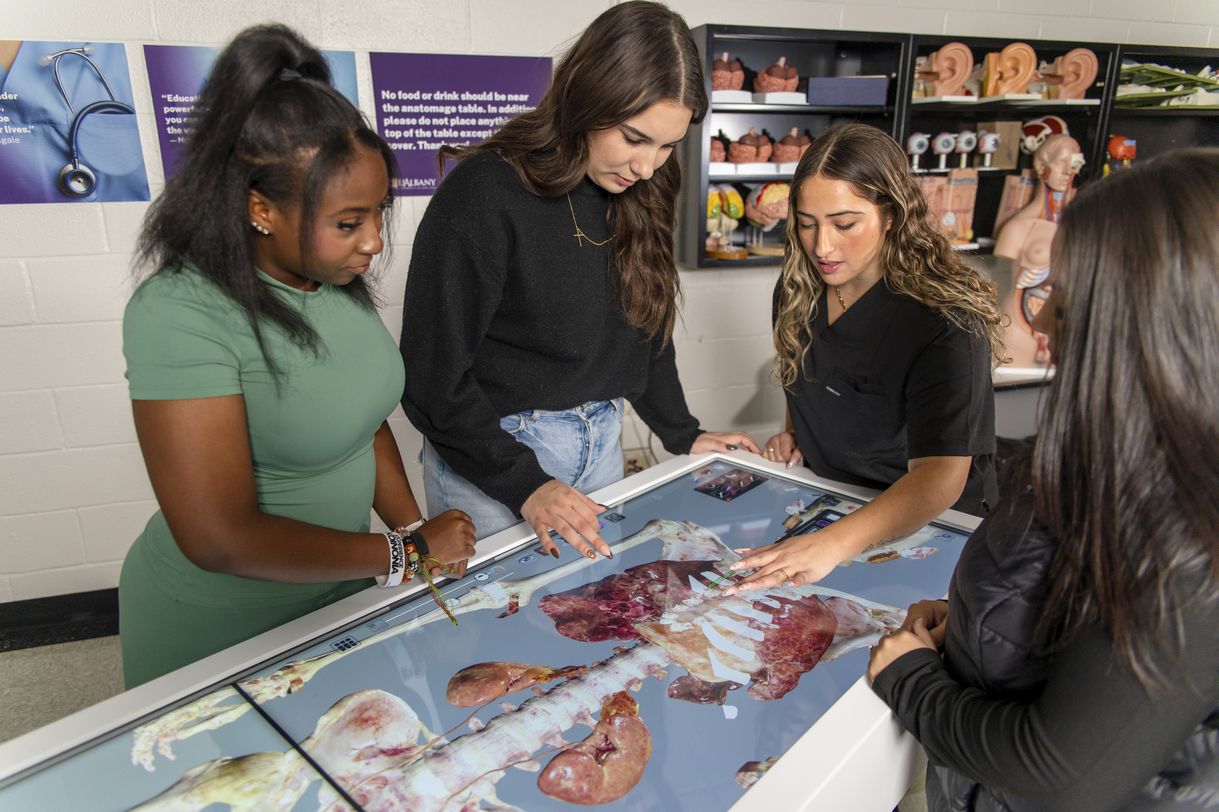
This spring, UAlbany launched a new four-year Bachelor of Science in Nursing degree in partnership with Albany Med Health System (AMHS). This collaboration enables students to take full advantage of learning in a Research-1 university setting, while enjoying access to cutting-edge facilities, clinical placements and expert faculty at a distinguished Level I trauma center. Students complete classroom and lab components on UAlbany’s main Uptown Campus while undertaking clinical rotations during all four years of the program at Albany Med Health System facilities throughout the Capital Region.
This new offering builds on UAlbany’s existing nursing degree programs which include the “1+2+1” Bachelor of Science in Nursing, the Bachelor of Science in Nursing completion program, and the Master of Science in Population Health Nursing. These programs are accredited by the Commission on Collegiate Nursing Education. This designation indicates that the unit meets the highest national standards for quality in nursing education as defined by the U.S. Department of Education.